
I thought it might be helpful to put together some questions you can ask yourself as you’re trying to evaluate your stances on policies or issues. Being willing to learn and to listen to understand is critical if we are to move forward as a United States and not broken states.
These are some of the questions I’ve learned to ask myself over the years. If you believe your stance is truly American, not partisan, maybe ask yourself a few questions:
- Whom does this stance or policy benefit?
- Whom does it harm?
- Is this policy Constitutional/legal?
- If you don’t know the answer, there are many great resources from Constitutional scholars available, like the Supreme Court.
- If it is restricting freedoms, it’s likely not.
- Is this view or policy moral and ethical?
- For Evangelicals, I’d add, what would the Jesus of the Gospels say about it? The real Jesus, not the prosperity gospel Jesus or the Republican Jesus.
- Does this harm my neighbor?
- Is this policy imposing my beliefs on others who do not share my faith?
- Does this policy or stance benefit the many or the few?
- Is this going to disproportionately benefit the rich while harming the poor?
- Is the source trying to make me angry (and are they making money off of my outrage)?
- What would I say if a member of the other party were doing or saying this? If they were treating people like this? What if another religious group were trying to impose their beliefs on me?
- This one can be challenging, but I think you know the answer. If the other party were enacting unpopular policies and bullying people, as an example, you’d likely be outraged. If a different religion were trying to impose their beliefs on you, you’d be outraged. So be outraged now. Stand up now, because wrong is wrong no matter which party or group does it.
- Step outside of your own political/religious identity and remember that these are humans with hopes and dreams and rights; they want most of the same things you do, just through different approaches. The other party/group is not evil just because that is what you have been taught.
- Does this policy promote racism, ableism, ageism, sexism, or any other kind of -ism, despite the narrative we’re being fed by those promoting the policy?
- What is the impact on the rest of the world? What are they saying about this?
- Does this policy match the vision I have for the future of the United States?
- Have I listened to those who say otherwise with the intent to understand and a willingness to change my mind?
- Does this policy make my future “better” at the expense of others?
- Does this policy stray from who America has always claimed to want to be?
- Is there something from history that can help guide my views on current events and help me see the patterns?
- Do the facts (from legitimate sources) match what the leader is saying? Why are they saying or doing this?
- Am I blindly trusting the leader and his policies (we’re all prone to this) simply because they are part of my chosen political party?
- Am I justifying these actions because I’ve made my politics my identity, and it’s hard to admit that my team is in the wrong because I take it personally?
- We are all prone to this, and it takes practice.
- Remember that humility is a strength, not a weakness.
- What are other sources saying?
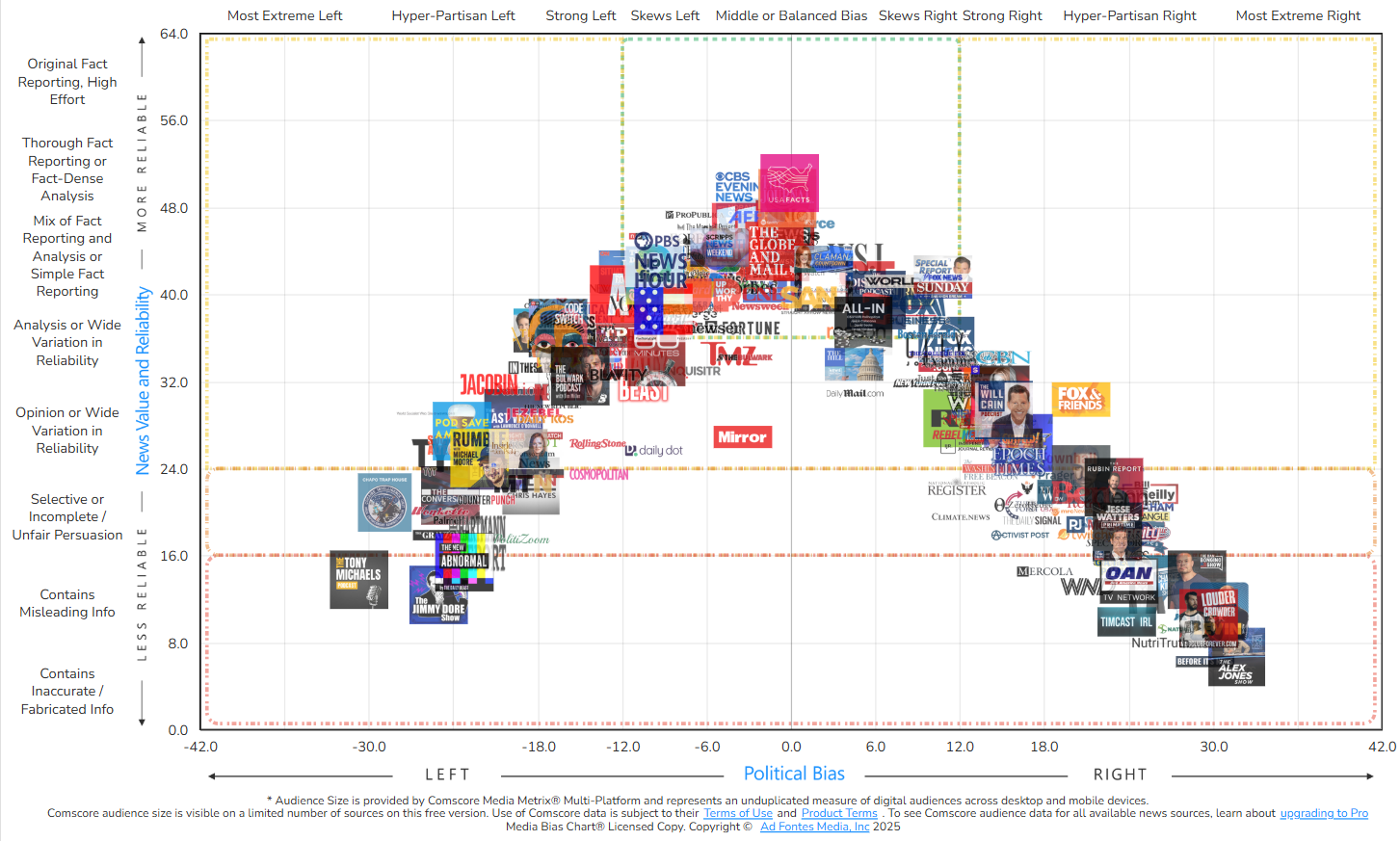
- Ad Fontes Media has a fantastic chart that shows both trustworthiness and how a source leans – try to stay with sources in the center.
- Remember, bias doesn’t always mean lying, but sometimes it does. You can look at individual sources on their website.
Learning to think like an American rather than through a partisan lens is challenging. It still challenges me, which is why I like to think through issues using the questions I mentioned above.
“Be curious, not judgmental.” – Ted Lasso
The most important thing is to assume that you might be wrong on an issue. That helps you to lower your pride and increase your desire to learn, to be accurate. This matters greatly.
When we see politics and policies being enacted that cause harm or restrict liberty, we need to speak up. When historic patterns are being followed, we need to stand up for our rights and those of our neighbors.
Because our very own Pledge of Allegiance says ” liberty and justice for all.” But do we believe it? Do we live it? Or are we blinded by partisanship and willing to remain complacent?
All includes the other political party. All includes other religious groups. All means ALL.
It’s up to you to decide how you want to live and view the world, but I hope you choose to love your neighbor.
 Even So, Joy