
If you’ve been following me for any length of time, you know that I am passionate about setting aside partisanship for the good of the country. This has been a decade-long journey for me, and it hasn’t been easy.
My life experience has taught me a crucial truth: following Jesus authentically requires a nonpartisan stance. Jesus would not be a Republican, nor would He be a Democrat. His priorities simply transcend the limits and boundaries of any single human political system.
This necessity for nonpartisanship comes from seeing clearly that both major political parties present a mixed bag of morality and spiritual contradiction. While each platform contains policies that genuinely reflect His priorities—like justice for the marginalized, protecting the vulnerable, or caring for the economy—each also holds attitudes or positions that fundamentally compromise those priorities. This duality makes it impossible for an individual committed to faith to ever offer unconditional, blinded loyalty to either side.
The Danger of Identity Fusion
The profound spiritual error we must avoid is allowing partisan affiliation to become our core identity. This challenge is amplified when our own faith leaders suggest that only one party is spiritually acceptable, making it incredibly difficult to separate party loyalty from our spiritual identity.
When we embrace the label of “Democrat” or “Republican” as who we are and place pride in that fact, we set up a massive psychological barrier to truth.
Pride ensures that critiquing party leaders or disagreeing with policies feels like criticizing ourselves. It makes open disagreement nearly impossible.
The Bible warns us repeatedly about this kind of pride and constantly encourages humility. Humility is the essential prerequisite for clear moral judgment.
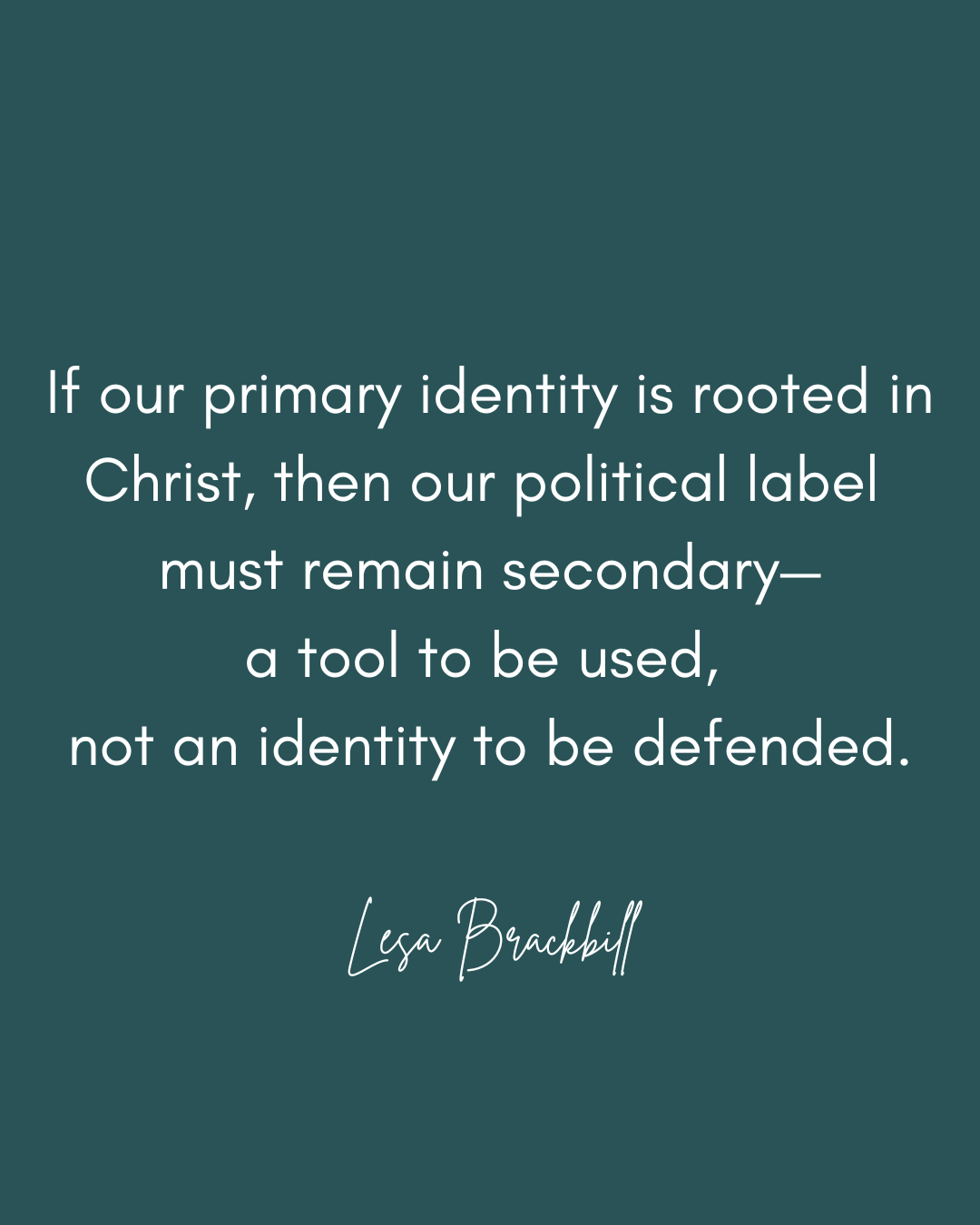
If our primary identity is rooted in Christ,
Lesa Brackbill
then our political label must remain secondary—
a tool to be used, not an identity to be defended.
The Duty of Humble Accountability
This spiritual principle directly informs our civic duty. Our preferred political leaders are not infallible. Everyone makes mistakes, everyone is tempted by the allure of power, and everyone can be tempted to use that power for revenge and retribution. The leader—regardless of party—is a human being susceptible to error and corruption.
It is precisely when a leader comes from our own party that our moral courage is most tested. Just because the president happens to be from your side doesn’t mean you cannot say that what he is doing is wrong; in fact, it is your duty, born of humility and spiritual independence, to call out behavior that is unlawful, harmful, or unjust.
No human being or political party deserves your undying loyalty or devotion.
By maintaining a nonpartisan identity, we retain the moral clarity necessary to hold everyone accountable, ensuring that our ultimate allegiance is to truth and righteousness, not to a political machine.
It enables us to put principle over party, country over party, people over party.
I encourage you to examine your own identity:
- Did these ideas make you feel defensive? If so, why?
- Are you able to openly critique the policies of your chosen party?
- Can you examine an action taken by your party leader and compare it to Jesus’ teachings?
- Are you able to admit that you and your party were perhaps wrong in an opinion you hold?
Humility requires the willingness to do both.
 Even So, Joy