I recently noticed that I have a “three-star” rating for my book. Just one.
No review, no explanation. Just a rating of three stars out of five.
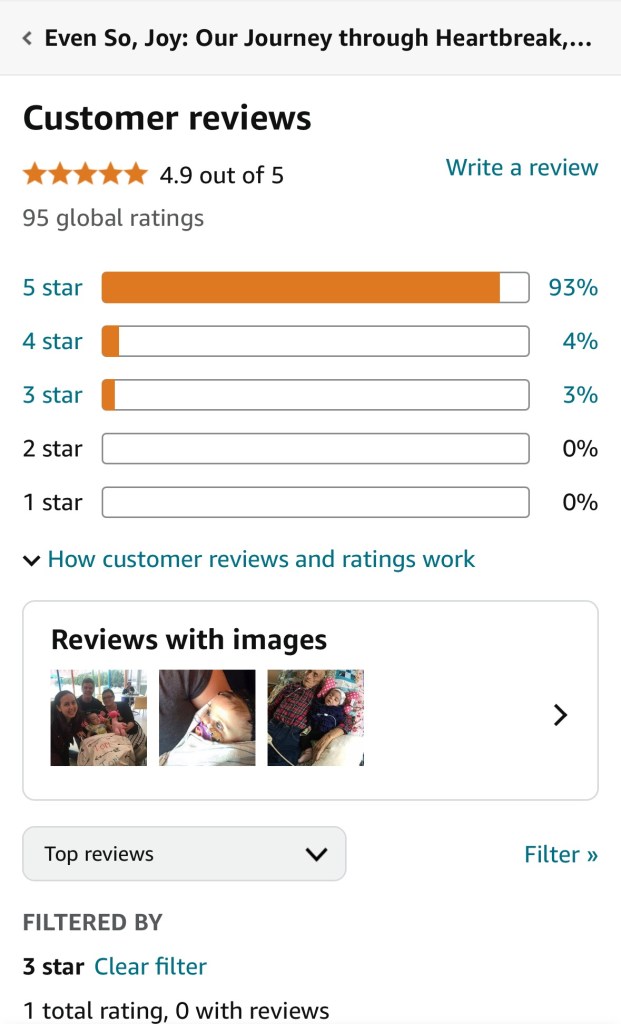
Out of 95 reviews, one person thought my book was average, and that’s reasonable. I get it. I knew my story wouldn’t resonate with everyone.
So why does it slightly bother me?
Perhaps for the same reason that I can be so discouraged when I find out someone doesn’t like me, even though I know that’s also reasonable. It’s allowed.
But it stings.
Rejection is a challenge for me. I recently learned about Rejection Sensitive Dysphoria, something that is common for people with ADHD (which I suspect I have); as I read through the symptoms I felt so seen:
According to the Cleveland Clinic,
“People with RSD often show the following traits and behaviors:
- It’s very easy for them to feel embarrassed or self-conscious.
- They show signs of low self-esteem and trouble believing in themselves.
- They have trouble containing emotions when they feel rejected.
- Instead of losing control of their emotions outwardly, some people with RSD may turn their feelings inward.
- They’re often “people pleasers” and become intensely focused on avoiding the disapproval of others.
- They may avoid starting projects, tasks or goals where there’s a chance of failure.
- They compensate for their fear of failure or rejection by going all-out or striving for perfectionism.
So many of those characteristics are in me.
I have not been diagnosed with this, but it was validating to see that possibly my sensitivity to rejection is a real thing, something that others face as well. That there is a valid reason behind it, if this is indeed part of my personality.
If this is true for me, it would help make sense of how I have responded to rejection in the past, and while that brings some peace, it doesn’t make it any less difficult for me.
Recently, I had an incredible week at my favorite conference of the year.
Amid the uncertainty I am experiencing regarding my career, I was affirmed and validated countless times; I was sought out for conversations about solutions by people who didn’t even know my name three years ago; I was even offered potential opportunities for the future.
After so many years of trying to find my place at the table, I feel as though I have found it.
I left that conference feeling as though my story mattered, my loss mattered, and that progress is being made in NBS for Krabbe in small part because of the work I do. It was humbling and exciting all at once.
And all of that was (nearly) wiped away by an encounter at the end of the conference.
I recently saw a meme that resonated with me:

In most areas of life, perception is reality. But when it comes to how people perceive us, it may not be. They bring their own experiences into every interaction, and just because they don’t understand you doesn’t mean it’s your fault.
I am very aware of the mistakes I make and I do everything to rectify them. Part of this is from perfectionism, part is just wanting to be a good human in every possible situation.
I have no illusions that I am perfect. In fact, it’s quite the opposite: I rarely feel good about myself.
I offer grace whenever I can (even if I don’t do it well at first), because I know we all have our own struggles, make mistakes, and deserve to be understood.
Similarly, I deal with imposter syndrome daily. I question my value and my belonging in the positions I find myself in so often, so I’m filled with gratitude (and a whole lot of humility) when given a place at the table.
Learning to listen to understand has helped with both of these matters, but as all humans do, I struggle.
So it caught me off guard when someone I considered a friend told me that I had made them frustrated and that distance was needed to protect their peace.
It left me in tears.
I asked questions. I tried to understand. And I was given no response. No explanation. Nothing except the impression that I am not worth the effort to resolve this unspoken conflict.
I felt like the week was a success. This person made me feel like a complete failure. Whose perception is correct? And why do I so easily allow the opinions of others to define me?
As I have processed this over the past couple of months, I keep coming back to the word intention.
I know that my heart was in the right place in every conversation, every interaction, everything I did that week. It is such a fulfilling week for me each year and I have little reason to be anything but grateful and content. I know that I strive to be the best possible version of myself in every situation, that doing the right thing and being kind are of utmost importance to me.
I always intend to be kind, patient, accepting, understanding. Do I always succeed? Of course not. But that is who I strive to be. Who I intend to be.
This person had a different view of how I handled myself and interacted with others during the week (though I don’t know specifics). Because I hate making mistakes and upsetting people, I wish I knew what I did to upset this person, more than anything. But maybe this isn’t actually about me.
And, conversely, in other situations maybe it’s more about me than what the person says.
Until I know, I need to remember that this person’s perception of me is not who I am, or who I want to be. And, I must remember that not everyone will like me, and I have to be okay with that, too. And vice versa.
Most importantly, I must learn to stop allowing others’ perception of me (or what I assume they perceive) to override what I know to be true about myself. I don’t mean that we shouldn’t accept feedback and continue to grow. I question why I give their passing judgments more weight than my own knowledge of myself.
Perception may be reality in marketing and politics, but it isn’t always reality when it comes to who we are. And that matters.


 Even So, Joy
Leave a reply to Louise Ann Wingate Cancel reply